Every science engenders some pseudo-science, inspiring eccentrics to explore freakish by-ways; astronomy has its parodists in astrology, chemistry used to have them in alchemy.
Wednesday, June 20
Selection from "Solaris"
We take off into the cosmos, ready for anything: for solitude, for hardship, for exhaustion, death. Modesty forbids us to say so, but there are times when we think pretty well of ourselves. And yet, if we examine it more closely, our enthusiasm turns out to be all sham. We don't want to conquer the cosmos, we simply want to extend the boundaries of Earth to the frontiers of the cosmos. For us, such and such a planet is as arid as the Sahara, another as frozen as the North Pole, yet another as lush as the Amazon basin. We are humanitarian and chivalrous; we don't want to enslave other races, we simply want to bequeath them our values and take over their heritage in exchange. We think of ourselves as the Knights of the Holy Contact. This is another lie. We are only seeking Man. We have no need of other worlds. We need mirrors. We don't know what to do with other worlds. A single world, our own, suffices us; but we can't accept it for what it is. We are searching for an ideal image of our own world: we go in quest of a planet, of a civilization superior to our own but developed on the basis of a prototype of our primeval past. At the same time, there is something inside us which we don't like to face up to, from which we try to protect ourselves, but which nevertheless remains, since we don't leave Earth in a state of primal innocence. We arrive here as we are in reality, and when the page is turned and that reality is revealed to us—that part of our reality which we would prefer to pass over in silence—then we don't like it any more."

Sunday, June 17

Wednesday, May 30
Sunday, May 20
Saturday, May 5

Thursday, April 26


I found a moth

This little guy was just chillin in the grass next to the bike racks on campus.
Funny what you see when you take the time to slow down and enjoy the life around you.
Wednesday, April 25
more throwing
here is some more time lapse footage of me throwing. This time I attempted a spouted pitcher
I am not really happy with the way my spout turned out it kinda sucks leaving the wheel with something you are not terribly proud of. It just reminds me that I have so much to learn when it comes to throwing. As with much of art, things look a lot easier to do than they really are.
trimming and handles will go on tomorrow, stay tuned
here are some pictures of the trimmed pieces I did from my last video


I am not really happy with the way my spout turned out it kinda sucks leaving the wheel with something you are not terribly proud of. It just reminds me that I have so much to learn when it comes to throwing. As with much of art, things look a lot easier to do than they really are.
trimming and handles will go on tomorrow, stay tuned
here are some pictures of the trimmed pieces I did from my last video


Sunday, April 22
Friday, April 13
Banks on advertising

Strong words and definitely has some logic to it. Seems like the solution would be to have a greater collective appreciation for the space we share instead if handing it over to marketers
This also makes me wonder about online advertising and online public space. Is there anyplace online that is truly a public place? Wikipedia? What about graffiti, which can be found in just about any public space in cities. Is there an equivalent online graffiti?
Wednesday, April 11
the mother of all thought experiments.
On Twin Earth, a brain in a vat is at the wheel of a runaway trolley. There are only two options that the brain can take: the right side of the fork in the track or the left side of the fork. There is no way in sight of derailing or stopping the trolley and the brain is aware of this, for the brain knows trolleys. The brain is causally hooked up to the trolley such that the brain can determine the course which the trolley will take.
On the right side of the track there is a single railroad worker, Jones, who will definitely be killed if the brain steers the trolley to the right. If the railman on the right lives, he will go on to kill five men for the sake of killing them, but in doing so will inadvertently save the lives of thirty orphans (one of the five men he will kill is planning to destroy a bridge that the orphans’ bus will be crossing later that night). One of the orphans that will be killed would have grown up to become a tyrant who would make good utilitarian men do bad things. Another of the orphans would grow up to become G.E.M. Anscombe, while a third would invent the pop-top can.
If the brain in the vat chooses the left side of the track, the trolley will definitely hit and kill a railman on the left side of the track, ‘Leftie,’ and will hit and destroy ten beating hearts on the track that could (and would) have been transplanted into ten patients in the local hospital that will die without donor hearts. These are the only hearts available, and the brain is aware of this, for the brain knows hearts. If the railman on the left side of the track lives, he too will kill five men, in fact the same five that the railman on the right would kill. However, ‘Leftie’ will kill the five as an unintended consequence of saving ten men: he will inadvertently kill the five men rushing the ten hearts to the local hospital for transplantation. A further result of ‘Leftie’s’ act would be that the busload of orphans will be spared. Among the five men killed by ‘Leftie’ are both the man responsible for putting the brain at the controls of the trolley, and the author of this example. If the ten hearts and ‘Leftie’ are killed by the trolley, the ten prospective heart-transplant patients will die and their kidneys will be used to save the lives of twenty kidney-transplant patients, one of whom will grow up to cure cancer, and one of whom will grow up to be Hitler. There are other kidneys and dialysis machines available; however, the brain does not know kidneys, and this is not a factor.
Assume that the brain’s choice, whatever it turns out to be, will serve as an example to other brains-in-vats and so the effects of his decision will be amplified. Also assume that if the brain chooses the right side of the fork, an unjust war free of war crimes will ensue, while if the brain chooses the left fork, a just war fraught with war crimes will result. Furthermore, there is an intermittently active Cartesian demon deceiving the brain in such a manner that the brain is never sure if it is being deceived.
What should the brain do?
– Michael F. Patton Jr., “Tissues in the Profession: Can Bad Men Make Good Brains Do Bad Things?”, Proceedings and Addresses of the American Philosophical Association, January 1988
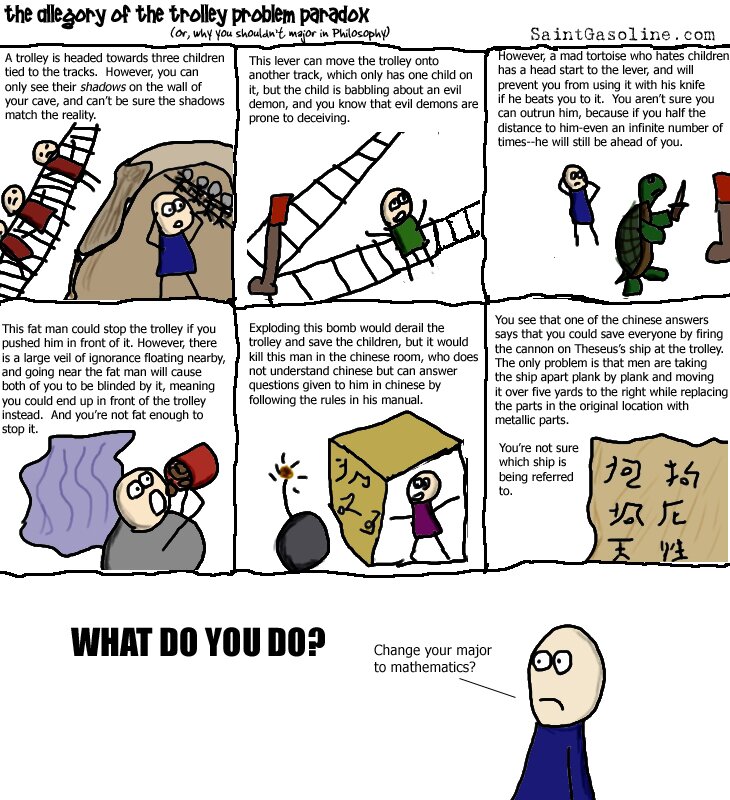
here is a comic along the same lines
Monday, April 9
reading hard books
There's no need for haste, the pages which lie ahead of you will lie ahead of you for as long as you like them to; it is perfectly all right if some things are at first unclear, and if there are references you don't recognize. Just go happily on; we don't stay in bed all day, do we? just because we've mislaid our appointment calendar. No, we need to understand this book--enjoy its charm, its wit, its irony, its erudition, its sensuous embodiment--the way we understand a spouse we have lived with and listened to and loved for many years through all their nights. Persons deserving such devotion and instinctual appreciation are rare; rarer still are the works which are worth it.
-William H. Gass
Sunday, April 8
nice tip
wish I knew about this before I scratched up my new handlebars. oh well at least it will be covered with bar tape


